The Crayonz JournalFabric & fit
Custom T-Shirt Embroidery vs Print: Which to Pick
What embroidery and printing each actually do to a design, and why Crayonz prints every order instead of stitching it.
By the Crayonz team5 min read
Embroidery and printing are two different ways of putting a design onto fabric, and they are not interchangeable. One stitches thread through the garment; the other lays ink or dye onto the surface. Crayonz prints every design made in the studio. This guide explains what that actually means for how a design looks and holds up, where embroidery genuinely wins elsewhere, and why printing is still the right call for the kind of designs people make here.
The short version, if you only read one line: embroidery is a craft built around a logo or a short wordmark on a thick, structured garment, repeated across many identical pieces. Printing is built around whatever is actually in the file, a photo, a gradient, fine linework, on any garment, one piece at a time. Almost everything made in the Crayonz studio falls into the second category, which is the real reason behind the choice, not a cost shortcut.
What each method actually does
Embroidery sews a design in thread, built up stitch by stitch from a digitised pattern, a conversion step where the artwork gets simplified into a stitch file before a single needle moves. Printing lays colour directly onto the fabric surface from a digital file, which is what Crayonz's AI-generated and uploaded designs already are, no conversion step in between.
The physical difference is easy to feel, not just see. Run a hand over an embroidered patch and the thread sits raised above the fabric, with a texture on the back where the stitching came through. A printed design sits flat against the surface, which is part of why it does not add weight or stiffness to a thin t-shirt the way a dense stitch pattern would.
| Embroidery | Printing | |
|---|---|---|
| Durability | Generally holds up longer, since stitched thread resists wear better than surface ink (source) | Typically fades or wears gradually over many washes, faster on polyester blends |
| Fine detail and colour | Struggles with gradients, photos and very fine text, since a stitch has a minimum size | Handles photos, gradients and fine illustration detail cleanly |
| Best suited to | Thicker, structured garments like polos and jackets (source) | Any garment, especially thinner tees where a dense stitch would feel stiff |
| Typical setup | Usually needs digitising before the first piece | No setup fee on Crayonz, no per-colour charge |
Where embroidery genuinely wins, elsewhere
This is worth saying plainly rather than skipped over: embroidery is the better finish for a specific, narrow job. A company logo, repeated identically across fifty polos for a team or a corporate order, on a thick, structured garment where the stitched texture adds to the look rather than fighting it. The thread genuinely survives more wash cycles than surface ink in that setting, and a small, simple mark digitises well without losing anything that mattered.
Outside that specific case, the tradeoffs start working against it. Digitising a design costs money and time before the first piece is even made, every colour change in the artwork adds a thread colour the machine has to switch to, and fine detail, gradients or photographic shading get flattened into blocks the stitch simply cannot resolve. Embroidery pricing elsewhere is usually quoted per piece plus that upfront digitising fee, which is exactly the setup cost Crayonz does not charge for printing.
There is also a size limit worth knowing either way. Very small text is one of the few things both methods struggle with: embroidery below a certain point stitches into an unreadable blob, and printed text under roughly 2cm tall can blur too. Neither method is a workaround for text that was simply designed too small to begin with, so the fix in both cases is the same, scale the type up before anything gets made.
Why Crayonz prints instead
Crayonz designs are either typed descriptions the AI draws or a buyer's own uploaded photo. Both are full-colour digital files from the start, photos, gradients, fine linework, which print cleanly but would lose most of their detail if translated into stitches, and most Crayonz orders are also a single piece rather than fifty identical ones, which is exactly where embroidery's upfront digitising cost stops making sense.
Full-colour digital printing reproduces what is actually in the file, made to order after payment, with no screen setup fee and no per-colour charge. A one-off order and a fifty-colour illustration cost the same to print as a plain single-colour wordmark, which would not be true of a stitched order priced by thread colour.
Where print holds detail embroidery would lose
A few kinds of design make the difference concrete, the ones where the choice of method is not a close call at all.
An uploaded photo, kept as a photo
A real photo, printed with its full gradient and shading intact, the kind of detail a stitched version would have to simplify into blocks of colour.
high-resolution photo treatment based on an uploaded photo, full gradient and shading preserved, print-ready
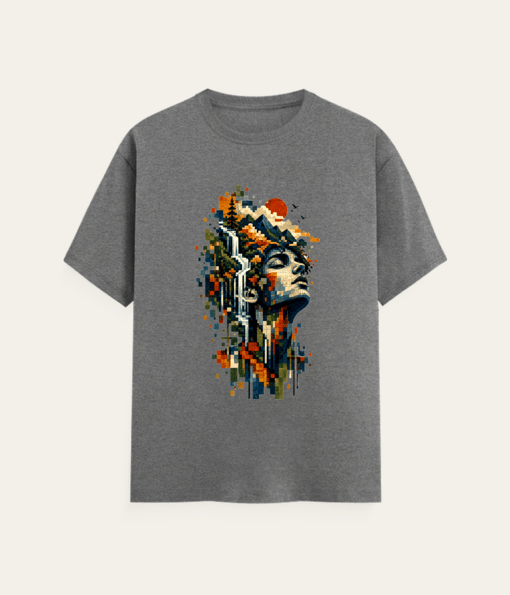
A detailed multi-colour illustration
A layered illustration with fine linework and several blended colours, the kind of detail a stitch count would have to flatten to stay affordable.
detailed multi-colour illustration of [a subject], fine linework, blended colours, centred chest placement, print-ready, plain background
A simple bold wordmark, clean either way
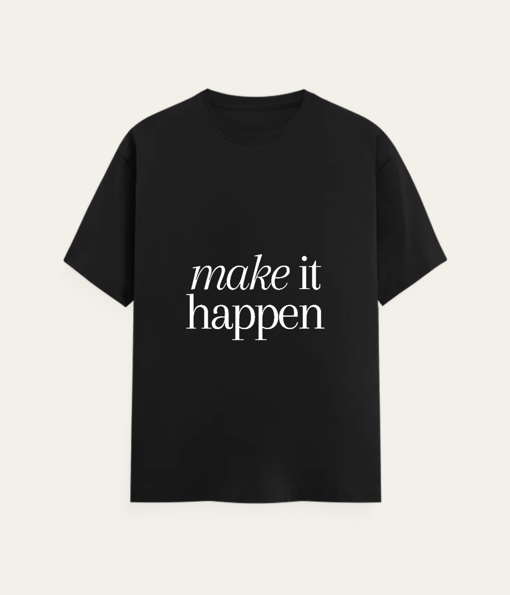
A plain, bold line of type, the one case where either method would look fine, printed here for consistency and speed across every order.
bold clean typography reading "[your word]", centred placement, single colour, print-ready, plain background
A quick way to tell which method a design actually needs
Ask two questions before assuming either method is right. First, does the design have a gradient, a photo or fine shading in it, or is it flat, solid colour shapes and bold type? Gradients and photos need printing; flat shapes can go either way. Second, is this a one-off piece or fifty identical ones for a team? One-off favours printing's lack of setup cost; a large identical run is where embroidery's durability starts to earn back its digitising fee.
Most of what gets made in the Crayonz studio answers both questions the same way: a one-off piece, often with a photo, a gradient or fine linework somewhere in it. That is the whole explanation, not a workaround or a compromise, and it is why the choice was never really a close call once the actual designs people make here are taken into account.
What this means for your order
Every Crayonz garment, including the Varsity Jacket at ₹1,799, is printed rather than embroidered or finished in chenille patches, even though a varsity jacket is the one garment where embroidery is the more traditional finish elsewhere. The printed version here still carries full colour and fine detail, and costs the same whether the design is simple or complex, since pricing is per piece and does not change with the number of colours.
That also means a design does not need to be simplified to survive the print process the way it would for a stitch count. A photo stays a photo, a gradient stays a gradient, and a 30-colour illustration prints for the same price as a single flat icon.
A stitch has a minimum size. A pixel does not. That is the whole reason Crayonz prints.
Clean prints already on Crayonz
Questions people ask
Does Crayonz offer embroidery?
No. Every garment is printed, including the Varsity Jacket, which is printed rather than embroidered or finished in chenille patches, since every Crayonz design starts as a full-colour digital file.
Which lasts longer, embroidery or print?
Embroidery generally holds up longer since stitched thread resists wear better than surface ink, though this varies by fabric and how often a piece is washed, and both last longer when washed cold and dried away from direct heat.
Can a photo be embroidered the way it can be printed?
Not with the same detail. A stitch has a minimum size, so gradients and fine shading in a photo get simplified when embroidered, while printing reproduces them directly, with no detail lost in a conversion step.
Does a more detailed design cost more to print?
No. There is no per-colour charge and no setup fee, pricing is per piece at any quantity regardless of how complex the design is, unlike embroidery where more thread colours usually mean more machine time.
Which Crayonz garment would normally be embroidered elsewhere?
The Varsity Jacket is the traditional candidate for embroidery or chenille patches elsewhere, but on Crayonz it is printed like every other garment, which is also what lets it carry full-colour detail rather than a simplified stitched mark.
Your idea, on a shirt, this week.
Upload a photo or describe it. One piece, no minimum, arrives in 4 to 8 days across India.